P-Hub B2B access is available for approved pharmacy members only.


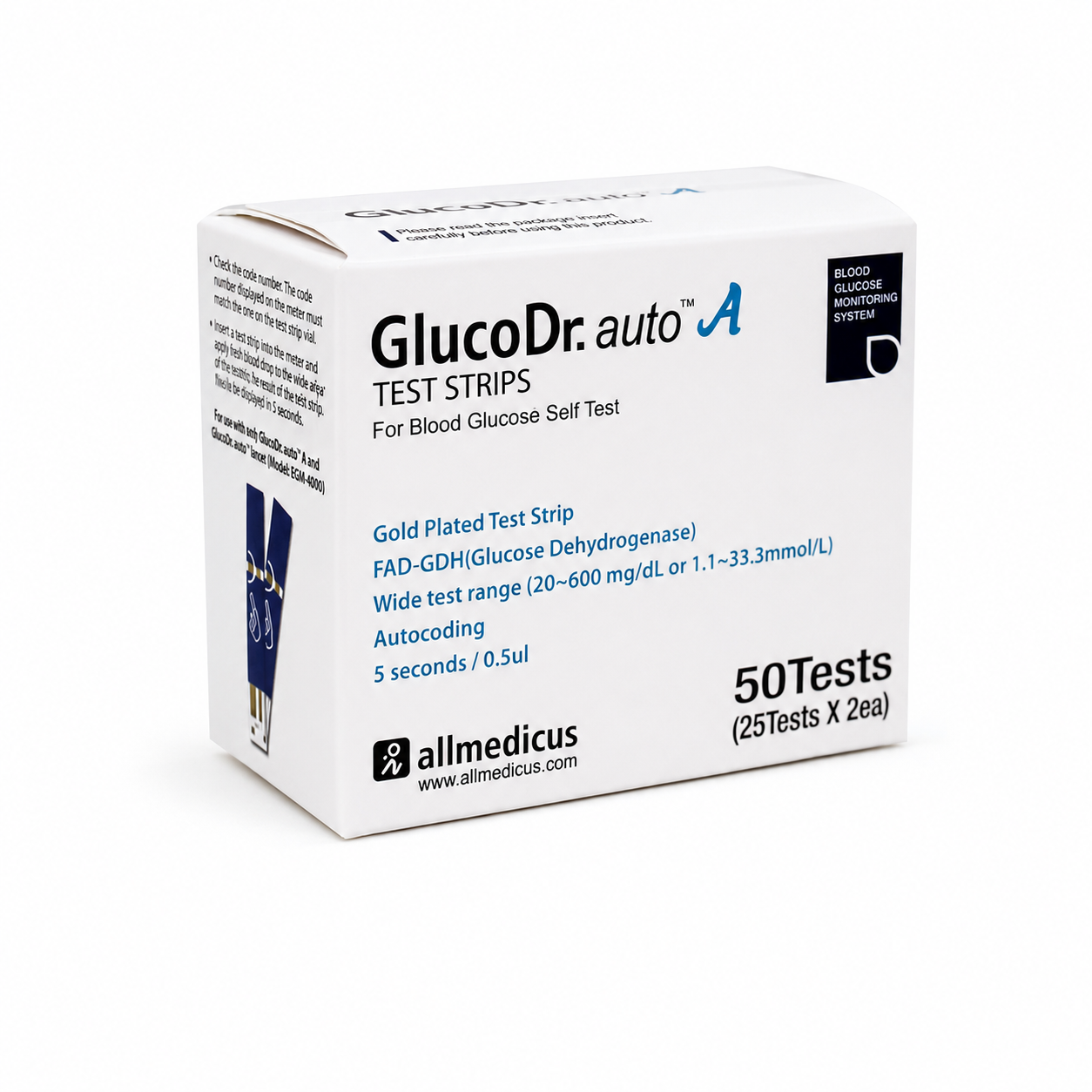

GlucoDr Auto A Blood Glucose Test Strips 50s
GlucoDr Auto A Blood Glucose Test Strips 50s are single-use in-vitro diagnostic strips designed for use with the GlucoDr Auto A AGM-4000 blood glucose meter. Each pack contains two vials of 25 strips and supports blood-glucose monitoring using a small approximately 0.5µL blood sample with results displayed in about five seconds.
Description
GlucoDr Auto A Blood Glucose Test Strips 50s are single-use in-vitro diagnostic test strips designed for use with the GlucoDr Auto A AGM-4000 blood glucose monitoring system.
Each pack contains 50 test strips supplied as two vials of 25 strips. The strips use an electrochemical glucose-dehydrogenase test principle and require only a small blood sample of approximately 0.5µL. When used correctly with the compatible meter, a blood-glucose result is displayed in approximately five seconds.
Compatibility is essential: these test strips should only be used with the meter model stated on the physical product packaging. Do not use GlucoDr Auto A strips with GlucoDr Navi, GlucoDr S, GlucoDr Gold or another GlucoDr meter unless the manufacturer specifically confirms compatibility.
GlucoDr Auto A Test Strips Product Information
| Product Name | GlucoDr Auto A Blood Glucose Test Strips |
|---|---|
| Compatible Meter | GlucoDr Auto A AGM-4000 blood glucose meter |
| Pack Size | 50 test strips |
| Pack Configuration | 2 vials of 25 test strips |
| Product Type | Blood glucose test strips |
| Device Classification | In-vitro diagnostic medical device |
| Test Principle | Electrochemical glucose-dehydrogenase method |
| Sample Type for Self-Testing | Fresh capillary whole blood |
| Approximate Sample Volume | 0.5µL |
| Approximate Result Time | 5 seconds |
| Supported Haematocrit Range | 20%–60% |
| Calibration | Plasma-equivalent |
| Use | Single use only |
| Manufacturer | All Medicus Co., Ltd., Republic of Korea |
| Malaysian Device Registration Number | IVDC31053176718 – verify against the supplied product packaging |
What Are GlucoDr Auto A Test Strips Used For?
GlucoDr Auto A test strips are used with the compatible AGM-4000 meter to quantitatively measure glucose in a fresh whole-blood sample.
The system may be used by people with diabetes for self-monitoring at home and by healthcare professionals as an aid in monitoring blood-glucose management.
Blood-glucose monitoring may help users and healthcare professionals assess glucose patterns in relation to:
- Meals and carbohydrate intake
- Diabetes medicines or insulin
- Physical activity
- Illness or infection
- Stress
- Changes in the diabetes-management plan
The frequency and timing of testing should follow the individual monitoring plan recommended by a doctor, pharmacist, diabetes educator or other qualified healthcare professional.
How GlucoDr Auto A Test Strips Work
A blood sample is drawn into the reaction chamber of the strip through capillary action.
Glucose in the sample reacts with the glucose-dehydrogenase enzyme and mediator in the test strip. This reaction creates an electrical current that is proportional to the glucose concentration in the blood.
The compatible GlucoDr Auto A meter measures the electrical signal and converts it into a plasma-equivalent blood-glucose result.
How to Use GlucoDr Auto A Test Strips
- Wash your hands with soap and water and dry them thoroughly.
- Remove one test strip from the vial using clean, dry hands.
- Close the test-strip vial immediately after removing the strip.
- Insert the strip into the GlucoDr Auto A AGM-4000 meter with the printed side facing upward.
- Confirm that the meter switches on and is ready to receive a blood sample.
- Check that the code number displayed by the meter corresponds with the number stated on the test-strip vial where applicable.
- Use a compatible sterile lancet and lancing device to obtain a blood drop.
- Touch the side edge of the strip’s yellow sample window to the blood drop.
- Allow the reaction chamber to fill completely.
- Wait for the meter to complete its countdown and display the result.
- Remove and safely discard the used strip and lancet.
Always follow the GlucoDr Auto A user manual and the instructions supplied with the current test-strip pack. Do not apply blood to an incorrect part of the strip or add more blood after the meter has begun testing.
Important Compatibility Information
Blood glucose test strips are meter-specific. Similar brand names do not mean that the strips are interchangeable.
- Use these strips only with the GlucoDr Auto A AGM-4000 meter.
- Do not use them with the GlucoDr Navi monitoring system.
- Do not use them with another GlucoDr model merely because the strip appears similar.
- Check the meter model number before supplying, purchasing or opening the pack.
- Verify the product name and compatibility statement on the physical carton and vial.
Using an incompatible strip may produce an error message, prevent the test from starting or result in an unreliable reading.
Important Test-Strip Precautions
- Test strips are for single use only.
- Do not reuse a strip after blood or control solution has been applied.
- Do not use a strip after the expiry date printed on its vial or carton.
- Do not use wet, bent, cut, damaged, dirty or discoloured strips.
- Do not handle strips with wet or contaminated hands.
- Do not transfer the strips into another container.
- Keep unused strips in their original vial.
- Close the vial cap tightly immediately after removing a strip.
- Do not expose the strips to excessive heat, humidity or direct sunlight.
- Do not store the strips in a bathroom, refrigerator or vehicle.
- Keep the strips, lancets and meter away from children.
Use Within Four Months After Opening
The manufacturer’s instructions state that the test strips should be used within four months after the vial is first opened, or before the printed expiry date, whichever comes first.
Write the opening date and calculated discard date on each vial when it is first opened. Discard any remaining strips once the applicable period has passed, even when the vial still contains unused strips.
Always follow a shorter discard period when the current Malaysian packaging states one.
When to Perform a Control-Solution Test
A GlucoDr Auto control-solution test checks whether the meter and test strips are working together correctly.
A control-solution test may be appropriate:
- When opening a new vial of test strips
- When the strip vial has been left open
- When the meter has been dropped or damaged
- When test results appear inconsistent
- When the result does not match the user’s symptoms
- When incorrect storage is suspected
- When the meter or strips may not be functioning correctly
Use only the control solution specified for the GlucoDr Auto A system. Compare the result with the control range printed on the test-strip vial.
The control-solution range is not a recommended blood-glucose target. It is used only to check system performance.
When a Reading Appears Incorrect
If a blood-glucose result appears unusually high, unusually low or inconsistent with the way the user feels:
- Wash and dry the hands thoroughly.
- Repeat the test using a new strip.
- Check the strip expiry and vial-opening date.
- Confirm that the vial was properly closed and stored.
- Confirm that the correct strip and meter model are being used.
- Perform a control-solution test when appropriate.
- Contact a healthcare professional if the repeated result remains concerning.
Do not delay urgent medical assessment merely to repeat multiple home glucose tests when severe symptoms are present.
Factors That May Affect Test Results
Test accuracy may be affected by:
- Insufficient blood applied to the strip
- Expired or damaged strips
- Incorrect storage
- Moisture inside the vial
- Dirty or wet hands
- Incorrect meter compatibility
- An incompletely filled reaction chamber
- Extreme operating temperature or humidity
- A haematocrit level outside the supported range
- Using an alternative testing site while glucose is changing rapidly
Consult the complete user manual for known limitations and substances that may interfere with the specific test system.
Alternative-Site Testing
The AGM-4000 system manual describes testing from certain alternative sites. However, alternative-site readings may differ from fingertip readings when blood glucose is changing rapidly.
Use a fingertip sample rather than an alternative site when:
- Low blood glucose is suspected
- The user has reduced awareness of hypoglycaemia
- The result does not match the way the user feels
- Testing soon after a meal
- Testing after insulin or diabetes medicine
- Testing after exercise
- The user is ill or under significant stress
Alternative-site testing should only be performed according to the system manual and professional advice.
Not Intended for Diabetes Diagnosis
GlucoDr Auto A test strips are intended to aid blood-glucose monitoring. The monitoring system should not be used on its own to diagnose diabetes or to screen a person for diabetes mellitus.
A diagnosis requires appropriate assessment and laboratory testing ordered or interpreted by a qualified healthcare professional.
The system is also not intended for neonatal testing.
When to Seek Medical Attention
Seek prompt medical advice when repeated blood-glucose readings are outside the individual target range or when unexplained high or low readings continue.
Seek urgent medical attention for serious symptoms such as:
- Confusion, fainting or loss of consciousness
- Seizure
- Severe weakness or inability to take oral glucose safely
- Persistent vomiting
- Severe dehydration
- Rapid or unusually deep breathing
- Severe abdominal pain
- Chest pain or significant breathing difficulty
- A very high or very low repeated reading accompanied by symptoms
Follow the emergency plan provided by the patient’s diabetes healthcare team.
Hygiene and Disposal
- Test strips are single-use items and should be discarded after testing.
- Never share a used test strip or lancet.
- Use a new sterile lancet for each test.
- Dispose of lancets in an appropriate sharps container.
- Follow local clinical-waste procedures in a professional healthcare setting.
- Clean and maintain the meter according to its user manual.
When a meter is used by more than one person in a professional setting, appropriate infection-control and disinfection procedures must be followed.
Storage Instructions
- Store the strips in their original vial.
- Keep the vial tightly closed when not in use.
- Store in a dry location protected from heat, humidity and direct sunlight.
- Do not refrigerate or freeze the test strips.
- Do not store the strips in a bathroom or vehicle.
- Keep away from children and pets.
- Use strips within four months after opening unless the product label specifies a shorter period.
- Do not use after the printed expiry date.
- Product packaging, lot number and expiry date may vary between supplied batches.
Frequently Asked Questions
Which meter uses GlucoDr Auto A test strips?
These strips are designed for use with the GlucoDr Auto A AGM-4000 blood glucose meter. Confirm the meter model and physical strip packaging before use.
Can GlucoDr Auto A strips be used with a GlucoDr Navi meter?
No. GlucoDr Navi uses its own compatible test strips. Blood glucose test strips should not be interchanged between meter models.
How many strips are supplied in one pack?
Each pack contains 50 test strips supplied as two vials of 25 strips.
How much blood is required for one test?
The compatible AGM-4000 system requires an approximately 0.5µL blood sample.
How long does a GlucoDr Auto A test take?
The blood-glucose result is generally displayed approximately five seconds after a sufficient blood sample has filled the strip’s reaction chamber.
Are GlucoDr Auto A strips reusable?
No. Each strip is designed for one test only and must be discarded after blood or control solution has been applied.
How long can the strips be used after opening?
The manufacturer’s instructions state that the strips should be used within four months after the vial is first opened or before the printed expiry date, whichever occurs first.
Should the strips be kept in the refrigerator?
No. The strips should not be refrigerated or frozen. Keep them in their original tightly closed vial and follow the storage conditions printed on the packaging.
Why must the vial be closed immediately?
Exposure to moisture and humidity may damage the test strips and affect performance. The vial should be closed immediately after a strip is removed.
Can a strip be used if it has been left outside the vial?
A strip should be used promptly after removal. Do not use a strip that has been exposed to moisture, dirt, excessive heat or uncertain storage conditions.
Can these strips diagnose diabetes?
No. The system is intended to aid blood-glucose monitoring and should not be used by itself to diagnose or screen for diabetes.
Can the strips be used for newborn babies?
No. The GlucoDr Auto A monitoring system is not intended for neonatal testing.
What should be done when a result does not match the user’s symptoms?
Repeat the test using clean, dry hands and a new strip. Check the strip expiry, storage and meter compatibility. Seek medical advice if the repeated result remains inconsistent or concerning.
What is the Malaysian registration number?
Malaysian product listings state device registration number IVDC31053176718. The number should be verified against the supplied carton and the current Medical Device Authority registration record before publication or procurement.
Who manufactures GlucoDr Auto A test strips?
The GlucoDr Auto A blood glucose monitoring system and compatible strips are manufactured by All Medicus Co., Ltd. in the Republic of Korea.
Can pharmacies request GlucoDr test strips through P-Hub?
GlucoDr Auto A Blood Glucose Test Strips 50s are listed in the P-Hub B2B catalogue for approved pharmacy members. Quotation, ordering eligibility and supply are subject to P-Hub membership requirements and current stock availability.
Medical Device Notice
GlucoDr Auto A test strips are single-use in-vitro diagnostic medical devices. Read the test-strip instructions and compatible meter user manual before use.
The information on this page is provided for pharmacy catalogue and professional product-reference purposes. It does not replace the manufacturer’s instructions, an individual diabetes-monitoring plan, laboratory testing or advice from a qualified healthcare professional.
Confirm the exact compatible meter, Malaysian registration number, packaging, lot number and expiry date on the physical product before procurement, supply or use.
Product Information Sources
- All Medicus – GlucoDr Blood Glucose Monitoring Systems
- All Medicus – GlucoDr Auto AGM-4000 User Manual
- CityMedic Malaysia – GlucoDr Auto A Product Information
- Medical Device Authority Malaysia – Medical Device Registration Information
Product information last reviewed: 11 July 2026.
Reviews (0)
Only logged in customers who have purchased this product may leave a review.
Shipping and Delivery


























Reviews
There are no reviews yet.