P-Hub B2B access is available for approved pharmacy members only.


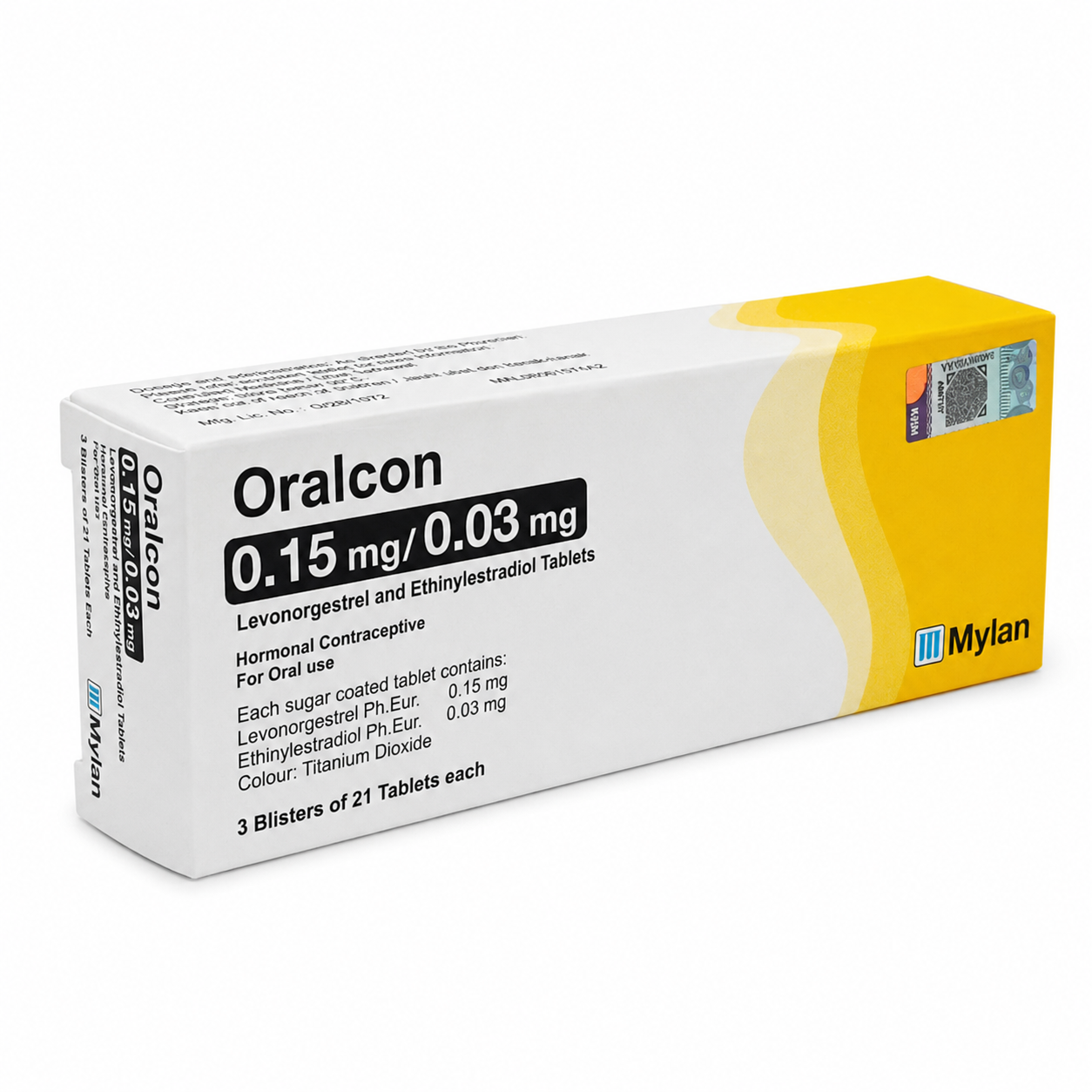

Oralcon 0.15mg/0.03mg Levonorgestrel/Ethinylestradiol Tablets 63s
Oralcon Combined Oral Contraceptive Tablets 63s is a prescription contraceptive containing levonorgestrel 0.15mg and ethinylestradiol 0.03mg per tablet. Each pack contains three blister strips of 21 active tablets for pregnancy prevention when taken according to the prescribed 21-day cycle.
Description
Oralcon 0.15mg/0.03mg Levonorgestrel/Ethinylestradiol Tablets 63s is a prescription combined oral contraceptive used to prevent pregnancy.
Each active tablet contains levonorgestrel 0.15mg, a synthetic progestogen, and ethinylestradiol 0.03mg, a synthetic oestrogen. The P-Hub presentation contains three blister strips of 21 active tablets, providing three contraceptive treatment cycles.
Oralcon must be taken consistently and according to the prescribed schedule. Missed tablets, delayed restarting after the tablet-free interval, vomiting, severe diarrhoea and interacting medicines may reduce contraceptive protection.
Oralcon does not protect against HIV infection or other sexually transmitted infections. Condoms may still be required for protection against sexually transmitted infections.
Oralcon Tablets 63s Product Information
| Product Name | Oralcon Tablet |
|---|---|
| Active Ingredients | Levonorgestrel and ethinylestradiol |
| Strength Per Tablet | Levonorgestrel 0.15mg and ethinylestradiol 0.03mg |
| Equivalent Strength | Levonorgestrel 150 micrograms and ethinylestradiol 30 micrograms |
| Dosage Form | Oral contraceptive tablet |
| Pack Size | 63 active tablets |
| Pack Configuration | 3 blister strips of 21 active tablets |
| Number of Treatment Cycles | Three 21-day contraceptive cycles |
| Placebo Tablets | None in the listed 63-tablet presentation |
| Therapeutic Class | Combined hormonal contraceptive |
| ATC Classification | G03AA07 |
| Medicine Classification | Prescription medicine |
| NPRA Classification | Prescription-Full |
| Malaysian Registration Number | MAL08061574AZ |
| Malaysian Registration Holder | Healol Pharmaceuticals Sdn. Bhd. |
| Manufacturer | Mylan Laboratories Limited, India |
| Route of Administration | Oral |
What Is Oralcon Used For?
Oralcon is used for oral contraception and the prevention of pregnancy in patients considered medically suitable for a combined hormonal contraceptive.
Combined oral contraceptives are highly effective when taken consistently and correctly. Their effectiveness may decrease when:
- One or more active tablets are missed
- A new blister is started late
- The tablet-free interval is extended beyond seven days
- Vomiting occurs shortly after taking a tablet
- Severe or prolonged diarrhoea affects absorption
- An interacting medicine reduces contraceptive hormone concentrations
Oralcon is not an emergency contraceptive. It should not be used as a substitute for a levonorgestrel or ulipristal emergency-contraception product after unprotected intercourse.
How Oralcon Works
Oralcon prevents pregnancy through several complementary hormonal effects.
Suppression of Ovulation
The levonorgestrel and ethinylestradiol combination suppresses the hormonal signals responsible for the development and release of an egg from the ovaries.
Changes to Cervical Mucus
The progestogen component makes cervical mucus thicker. This makes it more difficult for sperm to pass through the cervix.
Changes to the Endometrium
The hormones alter the lining of the uterus, making it less suitable for implantation.
Consistent daily use is required to maintain these effects throughout the contraceptive cycle.
How to Take the 21-Day Oralcon Pack
Follow the prescription, Malaysian package insert and directions printed on the blister pack.
- Take one active tablet daily for 21 consecutive days.
- Take each tablet at approximately the same time every day.
- After the twenty-first tablet, have a seven-day tablet-free interval.
- Withdrawal bleeding usually occurs during the tablet-free interval.
- Start the next 21-tablet blister on the eighth day.
- Start the next blister on schedule even if withdrawal bleeding has not finished.
The tablet-free interval must not exceed seven days. Extending the interval may allow ovulation to occur and reduce pregnancy protection.
Starting Oralcon for the First Time
When no hormonal contraceptive was used during the preceding month, the first tablet is commonly started on the first day of menstrual bleeding.
Starting later in the cycle may require additional barrier contraception for the first seven days. Exact starting instructions depend on:
- The day of the menstrual cycle
- Whether another combined contraceptive was used
- Whether the patient is changing from a progestogen-only method
- Whether an implant or intrauterine system has been removed
- The timing of the last contraceptive injection
- Recent pregnancy, miscarriage or termination
- Postpartum and breastfeeding status
A doctor or pharmacist should provide the appropriate start date and advise whether condoms are required temporarily.
What to Do If an Oralcon Tablet Is Taken Late
The Malaysian package insert supplied with the current product should always be followed. General reference guidance for this type of combined oral contraceptive includes the following:
Less Than 12 Hours Late
- Take the delayed tablet as soon as it is remembered.
- Take the next tablet at the normal time.
- This may mean taking two tablets on the same day.
- Contraceptive protection is generally maintained.
More Than 12 Hours Late or One or More Tablets Missed
- Contraceptive protection may be reduced.
- Take the most recently missed tablet as soon as possible.
- Continue the remaining tablets at the usual time.
- Use condoms or avoid sexual intercourse until seven consecutive active tablets have been taken correctly.
- Consult a pharmacist or doctor for advice based on the week of the blister and number of tablets missed.
Missed Tablets During the First Week
If tablets were missed near the beginning of the blister and unprotected intercourse occurred during the preceding seven days, pregnancy is possible. Obtain prompt professional advice regarding emergency contraception and pregnancy assessment.
Missed Tablets Near the End of the Blister
If fewer than seven active tablets remain after the missed tablet, the healthcare professional may advise completing the active tablets and starting the next blister immediately without the usual seven-day break.
Do not rely on memory or generic online instructions when several tablets have been missed. The correct response depends on the exact number of missed tablets and their position in the cycle.
Vomiting and Severe Diarrhoea
Vomiting within approximately three to four hours after taking an active tablet may prevent complete absorption. Severe diarrhoea may also reduce absorption.
In these circumstances:
- Follow the instructions for a missed active tablet.
- Take a replacement active tablet from another blister when instructed.
- Continue the remaining tablets at the usual time.
- Use condoms during the illness and for the period stated in the product insert.
- Obtain professional advice when vomiting or diarrhoea continues.
Oralcon Does Not Protect Against Sexually Transmitted Infections
Oralcon helps prevent pregnancy but does not protect against:
- HIV infection
- Chlamydia
- Gonorrhoea
- Syphilis
- Genital herpes
- Human papillomavirus infection
- Other sexually transmitted infections
Correct condom use can reduce the risk of many sexually transmitted infections.
Medical Assessment Before Starting Oralcon
Before prescribing a combined oral contraceptive, the healthcare professional should review the patient’s medical and family history and assess relevant risk factors.
The assessment may include:
- Blood-pressure measurement
- Smoking status
- Age and body mass index
- Personal or family history of blood clots
- History of stroke, heart attack or cardiovascular disease
- Migraine history, particularly migraine with aura
- Liver and gallbladder conditions
- Diabetes and vascular complications
- Unexplained vaginal bleeding
- Current and previous cancers
- Pregnancy and breastfeeding status
- Current medicines, supplements and herbal products
Periodic medical review and blood-pressure monitoring may be required during continued use.
Blood-Clot Warning
Combined oral contraceptives increase the risk of venous and arterial blood clots compared with not using a combined hormonal contraceptive.
Although blood clots are uncommon, they can be serious or life-threatening. The risk must be considered before Oralcon is prescribed and reassessed when health circumstances change.
Possible Symptoms of Deep-Vein Thrombosis
- Swelling of one leg or along a vein in the leg
- Pain or tenderness in one leg
- Warmth or discolouration affecting one leg
Possible Symptoms of Pulmonary Embolism
- Sudden unexplained breathlessness
- Rapid breathing
- Sudden cough, possibly with blood
- Sharp chest pain that may worsen with deep breathing
- Severe light-headedness or fainting
- Rapid or irregular heartbeat
Possible Symptoms of Stroke
- Sudden weakness or numbness affecting the face, arm or leg
- Symptoms affecting only one side of the body
- Sudden confusion or difficulty speaking
- Sudden loss or disturbance of vision
- Sudden difficulty walking, dizziness or loss of coordination
- A sudden severe or prolonged headache
- Loss of consciousness or seizure
Possible Symptoms of a Heart Attack
- Chest pain, pressure, heaviness or tightness
- Pain spreading to the arm, back, jaw, throat or stomach
- Breathlessness
- Sweating, nausea or severe weakness
- Rapid or irregular heartbeat
Stop taking Oralcon and seek urgent medical attention if symptoms of a blood clot, stroke or heart attack occur.
Factors That Increase Blood-Clot Risk
The risk of venous or arterial thrombosis may increase with:
- Previous blood clot, stroke or heart attack
- A known clotting disorder
- A close family member who developed a blood clot at a relatively young age
- Increasing age
- Smoking
- Obesity
- High blood pressure
- Diabetes with vascular complications
- Migraine with aura
- Severe abnormal blood-lipid levels
- Cancer
- Systemic lupus erythematosus
- Major surgery
- Prolonged immobilisation
- Extended air travel, particularly when other risk factors are present
- The postpartum period
Oralcon may be unsuitable when one major risk factor or several combined risk factors are present.
Smoking and Oralcon
Cigarette smoking increases the risk of serious cardiovascular complications from combined oral contraceptives. The risk increases with age and the number of cigarettes smoked.
Patients using a combined oral contraceptive should be strongly advised not to smoke. Patients aged over 35 who continue to smoke should generally be offered a contraceptive method without oestrogen.
Surgery and Immobilisation
Major surgery, trauma and prolonged immobilisation may substantially increase blood-clot risk.
Tell the surgeon or healthcare team that Oralcon is being used before:
- Planned major surgery
- Leg or pelvic surgery
- Neurosurgery
- A procedure expected to cause prolonged immobility
- Application of a leg cast
- Hospitalisation following serious injury
The doctor may advise stopping the combined contraceptive in advance and using a temporary alternative. Oralcon should only be restarted when the healthcare professional confirms that it is appropriate.
Who Should Not Take Oralcon?
Oralcon should not be used when the patient has a contraindication to combined hormonal contraception, including:
- A current or previous deep-vein thrombosis or pulmonary embolism
- A known hereditary or acquired blood-clotting disorder
- A current or previous heart attack, stroke or transient ischaemic attack
- Major surgery requiring prolonged immobilisation
- A high risk of venous or arterial thrombosis
- Migraine with focal neurological symptoms or aura
- Severe or uncontrolled hypertension
- Diabetes with vascular complications
- Severe liver disease while liver function remains abnormal
- A current or previous liver tumour
- Known or suspected breast cancer or another hormone-sensitive malignancy
- Unexplained vaginal bleeding
- Known or suspected pregnancy
- An allergy to levonorgestrel, ethinylestradiol or another tablet ingredient
The complete Malaysian package insert should be reviewed before prescribing or dispensing.
Migraine and Headache Precautions
A history of migraine must be discussed before starting Oralcon.
Migraine with aura or focal neurological symptoms is a contraindication because of the increased risk of stroke.
Stop taking Oralcon and obtain prompt medical assessment if there is:
- A first migraine attack
- A substantial increase in headache frequency
- A marked increase in migraine severity
- Visual disturbances
- Numbness, weakness or speech disturbance
- An unusual, severe or persistent headache
Mood Changes and Depression
Mood changes and depression have been reported during hormonal contraceptive use. Depression can be serious and requires appropriate assessment.
Contact a healthcare professional promptly if the patient develops:
- Persistent low mood
- Loss of interest or pleasure
- Severe anxiety
- Marked irritability or mood instability
- Social withdrawal
- Thoughts of self-harm or suicide
Urgent help is required for suicidal thoughts, self-harm behaviour or an immediate risk to safety.
Possible Side Effects
Not everyone experiences side effects. Effects commonly reported with combined oral contraceptives include:
- Nausea
- Abdominal discomfort or pain
- Headache
- Breast pain or tenderness
- Changes in mood
- Spotting or breakthrough bleeding
- Changes in menstrual bleeding
- Fluid retention
- Changes in body weight
Other possible effects include:
- Vomiting or diarrhoea
- Migraine
- Changes in sexual desire
- Skin rash or hives
- Contact-lens intolerance
- Vaginal or breast discharge
- Changes in blood pressure
- Changes in glucose or lipid measurements
Spotting and irregular bleeding may occur during the first several cycles. Persistent, heavy or newly developing bleeding should be medically assessed.
Serious Symptoms Requiring Urgent Attention
Stop taking Oralcon and seek urgent medical attention for:
- Symptoms of a blood clot
- Sudden chest pain or breathlessness
- Sudden weakness, numbness, speech difficulty or vision loss
- A new migraine with aura
- Severe or persistent abdominal pain
- Yellowing of the skin or eyes
- Swelling of the face, lips, tongue or throat
- Difficulty breathing or swallowing
- A severe or widespread skin reaction
- Severe depression or suicidal thoughts
Medicine and Herbal Interactions
Some medicines increase the breakdown of contraceptive hormones and may cause breakthrough bleeding or contraceptive failure.
Tell the doctor or pharmacist about all medicines and supplements, particularly:
- Rifampicin and rifabutin: may substantially reduce contraceptive effectiveness.
- Carbamazepine, phenytoin, phenobarbital and primidone: may reduce hormone concentrations.
- Oxcarbazepine and some doses of topiramate: may reduce contraceptive protection.
- Griseofulvin: may reduce effectiveness.
- St John’s wort: may cause breakthrough bleeding and contraceptive failure.
- Certain HIV and hepatitis medicines: may increase or reduce contraceptive hormone concentrations.
- Some direct-acting hepatitis C combinations: concurrent ethinylestradiol use may be contraindicated because of liver-enzyme elevations.
- Lamotrigine: combined contraceptives may reduce lamotrigine concentrations and affect seizure control.
Additional barrier contraception may be required during interacting treatment and for a period after it is stopped. Long-term enzyme-inducing treatment may require a contraceptive method unaffected by enzyme induction.
Do not stop an antiepileptic, antiviral or other essential medicine without advice from the prescribing healthcare professional.
Pregnancy
Oralcon must not be used during pregnancy.
If pregnancy is suspected or confirmed:
- Stop taking Oralcon.
- Contact the prescribing doctor or pharmacist.
- Arrange pregnancy assessment where appropriate.
Oralcon will not terminate an established pregnancy.
Breastfeeding and Postpartum Use
Combined oral contraceptives may reduce breast-milk production and alter its composition. Small amounts of contraceptive hormones may pass into breast milk.
They are generally not the first contraceptive choice during early breastfeeding. A progestogen-only or non-hormonal method may be more appropriate.
The period after delivery also carries an increased blood-clot risk. The appropriate time to start a combined oral contraceptive depends on:
- Whether the patient is breastfeeding
- Time since delivery
- Mobility
- Delivery complications
- Personal blood-clot risk factors
Do not start Oralcon after childbirth without specific medical instructions.
Use in Adolescents
Combined oral contraceptives are only indicated after menarche. Suitability must be individually assessed, including medical history, blood pressure, migraine symptoms and blood-clot risk.
Menstrual Changes
A withdrawal bleed commonly occurs during the seven-day tablet-free interval.
The bleeding may become:
- More predictable
- Lighter
- Shorter
- Less painful
Occasional spotting or breakthrough bleeding may occur, especially during the first cycles.
If withdrawal bleeding does not occur:
- Check whether tablets were missed.
- Check whether the tablet-free interval was extended.
- Consider vomiting, diarrhoea and interacting medicines.
- Perform a pregnancy test or seek professional advice where pregnancy is possible.
Do not start another blister when pregnancy is suspected without obtaining appropriate advice.
Storage Instructions
- Store according to the conditions stated on the Malaysian carton and package insert.
- Keep the tablets in their original blister packaging.
- Protect from heat, light and moisture.
- Do not store in a bathroom.
- Keep out of reach of children.
- Do not use after the expiry date printed on the carton or blister.
- Expiry varies by supplied batch.
Frequently Asked Questions
What are the active ingredients in Oralcon?
Each active tablet contains levonorgestrel 0.15mg and ethinylestradiol 0.03mg.
What is Oralcon used for?
Oralcon is a combined oral contraceptive used to prevent pregnancy.
How many tablets are supplied?
The P-Hub presentation contains 63 active tablets, arranged as three blister strips of 21 tablets.
Does the 63-tablet pack contain placebo tablets?
The listed Malaysian presentation is described as three strips of 21 active tablets. It does not include the seven placebo tablets found in some Oralcon 30 ED presentations sold in other countries.
How is the 21-tablet Oralcon pack taken?
Take one tablet daily for 21 consecutive days, followed by a seven-day tablet-free interval. Begin the next blister on the eighth day, even if withdrawal bleeding continues.
At what time should Oralcon be taken?
Take it at approximately the same time every day. Choose a time that can be followed consistently.
Can Oralcon be used as emergency contraception?
No. Oralcon is a regular daily combined contraceptive and is not an emergency-contraception product.
Does Oralcon protect against HIV or other sexually transmitted infections?
No. Condoms are required when protection against sexually transmitted infections is needed.
What should be done when a tablet is missed?
Follow the Malaysian package insert. Protection may be maintained when the tablet is taken less than 12 hours late, but delays exceeding 12 hours or multiple missed tablets may require condoms, emergency-contraception assessment or starting the next blister without a break.
What should be done after vomiting?
Vomiting within approximately three to four hours after taking a tablet may prevent complete absorption. Follow missed-tablet guidance and obtain professional advice if the illness continues.
Can Oralcon cause blood clots?
Combined oral contraceptives increase the risk of venous and arterial blood clots. The individual risk should be assessed before treatment and whenever health circumstances change.
Can smokers take Oralcon?
Smoking increases cardiovascular risk. Patients using combined oral contraceptives should not smoke, and patients aged over 35 who continue to smoke generally require an alternative method without oestrogen.
Can Oralcon be taken by someone with migraine?
Migraine must be assessed before prescribing. Migraine with aura or focal neurological symptoms is a contraindication to combined hormonal contraception.
Can Oralcon affect mood?
Yes. Mood changes and depression have been reported. Persistent depression, severe mood changes or thoughts of self-harm require prompt professional assessment.
Can antibiotics affect Oralcon?
Most routine antibiotics do not reduce combined contraceptive effectiveness, but rifampicin and rifabutin are important enzyme inducers and can substantially reduce protection. Vomiting or diarrhoea caused by any illness or antibiotic may also affect absorption.
Can Oralcon be used during pregnancy?
No. Stop taking Oralcon and obtain professional advice if pregnancy is suspected or confirmed.
Can Oralcon be used while breastfeeding?
Combined oral contraceptives may reduce milk production and are generally not preferred during early breastfeeding. The appropriate method and starting time should be selected by a healthcare professional.
Is Oralcon a prescription medicine in Malaysia?
Yes. Oralcon is registered under the Prescription-Full classification and should only be supplied according to applicable Malaysian prescription requirements.
What is the Malaysian registration number?
The Malaysian registration number is MAL08061574AZ.
Who holds the Malaysian registration?
The Malaysian product registration holder is Healol Pharmaceuticals Sdn. Bhd.
Who manufactures Oralcon?
The current NPRA registration record lists Mylan Laboratories Limited, India, as the manufacturer.
Can pharmacies request Oralcon through P-Hub?
Oralcon Combined Oral Contraceptive Tablets 63s is listed in the P-Hub B2B catalogue for approved pharmacy members. Quotation, ordering eligibility and supply are subject to P-Hub membership requirements, prescription medicine controls and current stock availability.
Prescription Medicine Notice
Oralcon is a prescription combined hormonal contraceptive. It should only be supplied and used after assessment of pregnancy status, blood pressure, migraine history, smoking status, thromboembolism risk, concurrent medicines and other relevant contraindications.
The information on this page is provided for pharmacy catalogue and professional product-reference purposes. It does not replace contraceptive counselling, an individual medical assessment, a valid prescription, the approved Malaysian package insert or advice from a qualified healthcare professional.
Product appearance, packaging, batch number, availability and expiry date may vary. Verify all information on the physical Malaysian carton, blister and approved insert before dispensing or use.
Product Information Sources
- NPRA Malaysia – Oralcon Registration Renewal
- Medsafe – Oralcon 30 ED Professional Data Sheet
- Medsafe – Oralcon Consumer Medicine Information
- Electronic Medicines Compendium – Levonorgestrel/Ethinylestradiol 21-Day Regimen
Product information last reviewed: 12 July 2026.
Reviews (0)
Only logged in customers who have purchased this product may leave a review.
Shipping and Delivery
























Reviews
There are no reviews yet.