P-Hub B2B access is available for approved pharmacy members only.


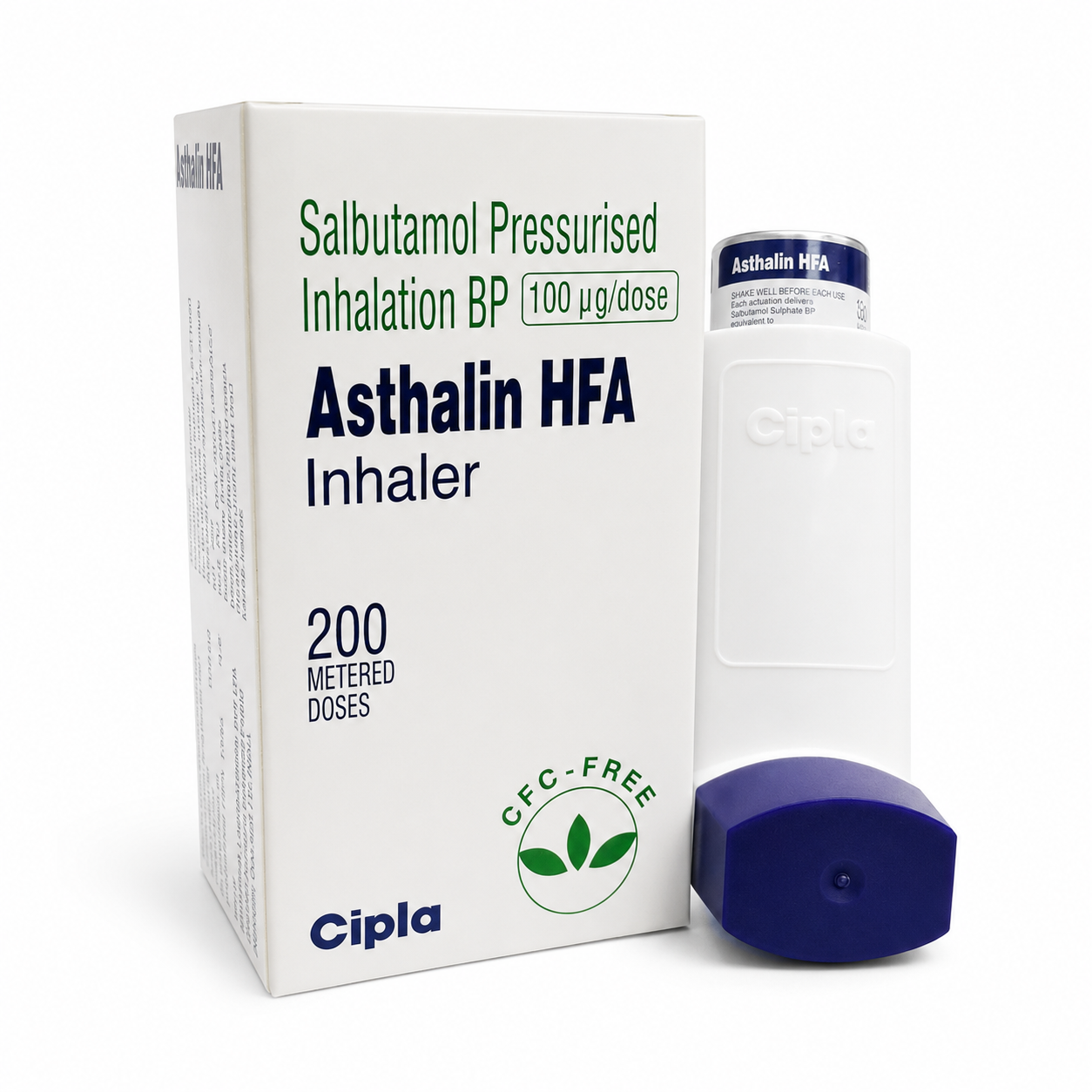

Asthalin HFA 100mcg Salbutamol Inhaler 200 Doses
Asthalin HFA 100mcg Salbutamol Inhaler 200 Doses is a prescription short-acting bronchodilator used for rapid relief of reversible bronchospasm, wheezing, chest tightness and shortness of breath. Each actuation delivers salbutamol 100mcg. It is a reliever inhaler and does not replace prescribed inhaled-corticosteroid treatment.
Description
Asthalin HFA 100mcg Salbutamol Inhaler 200 Doses is a prescription pressurised metered-dose inhaler containing salbutamol sulphate equivalent to salbutamol 100 micrograms per actuation.
Salbutamol is a short-acting beta-2 agonist bronchodilator, commonly abbreviated as a SABA. It rapidly relaxes tightened airway muscles and helps relieve reversible bronchospasm, wheezing, chest tightness, coughing and shortness of breath.
The inhaler generally begins working within approximately five minutes, and its bronchodilator effect commonly lasts for four to six hours.
Asthalin is a reliever inhaler, not an inhaled corticosteroid or preventer medicine. It relieves airway tightening but does not treat the underlying airway inflammation associated with asthma.
Asthma should not normally be managed with salbutamol alone. Patients should continue any prescribed inhaled corticosteroid or other controller treatment even when symptoms improve.
Asthalin HFA 100mcg Product Information
| Product Name | Asthalin HFA Metered Dose Inhaler 100mcg/Actuation |
|---|---|
| Active Ingredient | Salbutamol sulphate |
| Equivalent Salbutamol Strength | 100mcg per actuation |
| Alternative Ingredient Name | Albuterol |
| Dosage Form | Pressurised metered-dose inhalation aerosol |
| Common Device Abbreviation | pMDI |
| Number of Doses | 200 metered actuations |
| Propellant | Hydrofluoroalkane HFA-134a; non-CFC formulation |
| Therapeutic Class | Short-acting selective beta-2 agonist bronchodilator |
| Common Medicine-Class Abbreviation | SABA |
| ATC Classification | R03AC02 |
| Approximate Onset | Within about 5 minutes |
| Approximate Duration | 4–6 hours |
| Medicine Classification | Prescription medicine |
| NPRA Classification | Prescription-Full |
| Malaysian Registration Number | MAL20041029ACZ |
| Malaysian Registration Holder | Cipla Malaysia Sdn. Bhd. |
| Registered Manufacturer | Medispray Laboratories Pvt. Ltd., India |
| Route of Administration | Oral inhalation |
What Is Asthalin HFA Used For?
Asthalin HFA is used for the rapid relief or prevention of reversible bronchospasm in suitable patients.
It may be prescribed to relieve respiratory symptoms associated with:
- Bronchial asthma
- Exercise-induced bronchoconstriction
- Exposure to a known asthma trigger
- Chronic obstructive pulmonary disease with a reversible bronchospastic component
- Other reversible obstructive-airway conditions assessed by a doctor
Symptoms that may respond to salbutamol include:
- Wheezing
- Chest tightness
- Shortness of breath
- Breathlessness associated with bronchospasm
- Cough caused by reversible airway narrowing
Asthalin relieves bronchospasm but does not treat pneumonia, pulmonary oedema, a blood clot in the lung, heart failure or another non-bronchospastic cause of breathlessness.
How Asthalin Works
Salbutamol activates beta-2 adrenergic receptors in the smooth muscle surrounding the airways.
This action:
- Relaxes tightened bronchial muscles
- Widens the airways
- Reduces resistance to airflow
- Helps air move more easily into and out of the lungs
- Provides rapid symptom relief during reversible bronchospasm
Salbutamol does not provide the anti-inflammatory effect of an inhaled corticosteroid.
Asthalin Is a Reliever, Not a Preventer Inhaler
Asthalin is commonly called a reliever, rescue or blue inhaler. It is intended to provide rapid relief when airway muscles tighten.
A preventer or controller inhaler commonly contains an inhaled corticosteroid, either alone or combined with another bronchodilator. Controller treatment reduces airway inflammation and the risk of serious asthma exacerbations.
Patients prescribed an inhaled corticosteroid should continue it according to their treatment plan, even when they feel well and do not require Asthalin.
Salbutamol-Only Asthma Treatment Is Not Recommended
Current international asthma guidance advises against treating asthma solely with an as-needed SABA such as salbutamol.
Frequent or exclusive reliance on a salbutamol inhaler may:
- Mask worsening airway inflammation
- Delay adjustment of controller treatment
- Increase the risk of severe asthma exacerbations
- Reduce the bronchodilator response when salbutamol is urgently needed
- Be associated with an increased risk of asthma-related hospitalisation or death
The prescriber should confirm that the patient has an appropriate inhaled-corticosteroid-containing asthma plan.
Reference Dosage
Use Asthalin only according to the prescription, dispensing label, Malaysian package insert and individual asthma or COPD action plan.
Relief of Acute Bronchospasm
Reference Asthalin product information commonly recommends:
- One inhalation as the initial dose
- A second inhalation when required and prescribed
- Waiting approximately 30 seconds between inhalations
- Shaking the inhaler again before each actuation
Before Exercise or a Known Trigger
One or two inhalations may be prescribed approximately 10–15 minutes before exercise or unavoidable exposure to a recognised trigger.
Maximum Routine Reference Dose
Reference Asthalin product information states that the maximum routine dose should not exceed eight inhalations in 24 hours and repeated doses should not normally be taken more frequently than every four hours.
Emergency asthma-action plans may contain different instructions for a severe attack. Follow the patient-specific emergency plan and seek urgent medical care rather than repeatedly exceeding the prescribed routine dose.
Increasing Use Indicates Poorer Asthma Control
Contact a doctor, pharmacist or asthma-care professional when:
- Asthalin is required more frequently than usual
- It is needed on more than two days each week, excluding pre-exercise use
- Symptoms repeatedly wake the patient at night
- The usual dose provides less relief
- Relief lasts for less than approximately three hours
- A new inhaler is being finished unusually quickly
- Physical activity is increasingly limited by breathing symptoms
Do not simply increase the number of inhalations without professional assessment. The controller treatment, inhaler technique, diagnosis and exposure to triggers may require review.
How to Use the Asthalin HFA Inhaler
- Remove the mouthpiece cover.
- Check inside and outside the mouthpiece for dust, dirt or another obstruction.
- Shake the inhaler well.
- Hold the inhaler upright with the mouthpiece at the bottom.
- Breathe out gently and fully, away from the inhaler.
- Place the mouthpiece between the teeth without biting it.
- Close the lips firmly around the mouthpiece.
- Begin breathing in slowly and deeply through the mouth.
- Immediately after beginning to inhale, press the canister once.
- Continue breathing in slowly and deeply.
- Remove the inhaler from the mouth.
- Hold the breath for approximately 10 seconds, or as long as comfortable.
- Breathe out slowly.
- For a second inhalation, wait approximately 30 seconds.
- Shake the inhaler again and repeat the procedure.
- Replace the mouthpiece cover after use.
Correct coordination between pressing the canister and breathing in is essential. A doctor, pharmacist, nurse or respiratory educator should periodically observe and correct the patient’s inhaler technique.
How to Check the Inhalation Technique
When practising in front of a mirror, look for aerosol escaping from the top of the inhaler or around the sides of the mouth.
Visible mist escaping may indicate that:
- The canister was pressed before inhalation began
- The patient breathed in too quickly
- The lips did not seal around the mouthpiece
- The patient stopped inhaling immediately after actuation
Repeat the technique assessment with a healthcare professional rather than repeatedly firing additional doses.
Priming the Inhaler
Reference Asthalin instructions state that a new inhaler should be primed before first use.
Priming may also be required when the inhaler has not been used for seven days or longer.
- Remove the mouthpiece cover.
- Check that the mouthpiece is clean and unobstructed.
- Shake the inhaler well.
- Point it away from the face.
- Release two test sprays into the air.
Follow the priming instructions in the Malaysian package insert supplied with the physical product if they differ.
Cleaning the Inhaler
The plastic actuator should generally be cleaned at least once each week to prevent blockage.
- Remove the metal canister from the plastic actuator.
- Remove the mouthpiece cover.
- Rinse the plastic actuator and mouthpiece cover under clean tap water.
- Allow water to run through both ends of the actuator.
- Do not place the metal canister in water.
- Do not wash or wipe the valve stem on the metal canister with water.
- Shake excess water from the plastic parts.
- Allow them to dry completely in a warm place.
- Do not use direct or excessive heat for drying.
- Reassemble the inhaler only when every plastic component is completely dry.
A wet or blocked actuator may deliver an unreliable amount of medicine.
Spacer Compatibility
Spacer compatibility depends on the exact inhaler actuator and manufacturer instructions.
Do not assume that every salbutamol inhaler or spacer can be used interchangeably. Confirm compatibility using:
- The current Malaysian Asthalin package insert
- The spacer manufacturer’s compatibility information
- Instructions from the prescribing doctor, pharmacist or respiratory-care professional
If a spacer is clinically required but is not compatible with the supplied Asthalin actuator, the prescriber may need to select a different inhaler presentation.
How to Know When the Inhaler Is Empty
The canister contains 200 metered actuations. An inhaler without a dose counter may continue to produce a spray after the labelled number of doses has been used, but the spray may contain insufficient medicine.
Patients should:
- Record the date the inhaler was started
- Track the approximate number of treatment and priming actuations
- Obtain a replacement before 200 actuations are reached
- Keep a spare reliever inhaler where clinically advised
- Never place the canister in water to estimate the amount remaining
Important Safety Information
- Use only the prescribed number of inhalations.
- Do not use Asthalin as the only long-term asthma medicine unless a specialist has provided a specific treatment plan.
- Continue inhaled corticosteroid treatment as prescribed.
- Have the inhaler technique checked regularly.
- Seek medical review when salbutamol use increases.
- Tell the doctor about heart disease, abnormal heart rhythm, high blood pressure, diabetes, overactive thyroid or low blood potassium.
- Tell the healthcare professional about every other bronchodilator and respiratory medicine being used.
- Do not use another person’s inhaler.
Possible Side Effects
Not everyone experiences side effects. Effects commonly associated with inhaled salbutamol include:
- Fine trembling or shaking of the hands
- Feeling tense or nervous
- Headache
- Dizziness
- Faster heartbeat
Other possible effects include:
- Palpitations
- Muscle cramps
- Muscle discomfort
- Throat irritation
- Mouth irritation
- Dry mouth
- Nausea
- Sleep disturbance
Side effects are more likely when the inhaler is used more frequently or at a higher dose than prescribed.
Paradoxical Bronchospasm
Very rarely, an inhaled medicine can cause immediate worsening of airway narrowing instead of relieving it.
Stop using the inhaler and obtain urgent medical assistance if an actuation causes:
- Immediate worsening of wheezing
- Sudden chest tightness
- Markedly increased breathlessness
- A sudden fall in airflow immediately after inhalation
An alternative rapid-acting bronchodilator and medical assessment may be required.
Low Blood Potassium
Beta-2 agonists can lower blood-potassium levels, particularly when high doses are used during severe asthma.
The risk may increase with:
- Diuretic medicines
- Systemic or high-dose corticosteroids
- Theophylline or another xanthine medicine
- Long-term or excessive laxative use
- Low oxygen levels
- Repeated high-dose salbutamol administration
Possible symptoms include muscle weakness, muscle cramps, palpitations or an irregular heartbeat.
Heart-Related Precautions
Salbutamol can increase heart rate and may cause palpitations. Additional caution may be required in patients with:
- Ischaemic heart disease
- Heart failure
- Abnormal heart rhythms
- Hypertrophic obstructive cardiomyopathy
- Uncontrolled high blood pressure
- Overactive thyroid
Seek prompt medical assessment for chest pain, persistent rapid heartbeat, a new irregular heartbeat, fainting or severe dizziness.
Lactic Acidosis During High-Dose Treatment
High or repeated doses of short-acting beta-2 agonists used during severe asthma have rarely been associated with increased blood lactate and lactic acidosis.
Rapid breathing that persists or worsens despite improvement in wheezing may not always mean that additional salbutamol is required. Urgent clinical assessment is necessary.
Medicine Interactions
Tell the doctor and pharmacist about all prescription medicines, non-prescription medicines, traditional products and supplements being used.
Medicines requiring particular consideration include:
- Non-selective beta blockers: medicines such as propranolol may block the bronchodilator effect and provoke bronchospasm.
- Diuretics: may increase the risk of low blood potassium.
- Corticosteroids: systemic treatment may increase potassium and glucose-related metabolic effects.
- Theophylline and other xanthines: may increase cardiac stimulation and potassium loss.
- Digoxin: cardiovascular effects may require additional monitoring.
- Tricyclic antidepressants and monoamine oxidase inhibitors: may increase cardiovascular effects.
- Other beta-2 agonists: combined use may increase tremor, palpitations, tachycardia and metabolic effects.
- Certain anaesthetic agents: the anaesthetist must be informed that salbutamol is being used.
Do not stop a beta blocker or another essential cardiovascular medicine without advice from the prescribing doctor.
Pregnancy and Breastfeeding
Patients who are pregnant, planning pregnancy or breastfeeding should inform their doctor or pharmacist.
Maintaining good asthma control during pregnancy is important for both the patient and baby. A prescribed salbutamol inhaler should not be stopped independently because uncontrolled asthma can also create serious risks.
The treating healthcare professional should review the complete asthma plan and confirm the appropriate reliever and controller medicines.
Use in Children
Salbutamol inhalers may be prescribed for children, but the dose, inhaler technique and choice of delivery device must be appropriate for the child’s age and ability.
Children who cannot reliably coordinate actuation with inhalation may require a different inhaler or a compatible spacer system selected by a healthcare professional.
Do not give a child an adult inhaler regimen without professional instructions.
When to Seek Urgent Medical Attention
Seek urgent medical assistance when:
- Breathing is rapidly worsening
- The inhaler provides little or no relief
- Relief lasts for only a short period
- The patient cannot speak in complete sentences
- The lips, face or fingertips appear blue or grey
- The patient becomes confused, exhausted or unusually drowsy
- There is severe chest tightness or chest pain
- There is a persistent fast or irregular heartbeat
- The inhaler causes immediate worsening of wheezing
- There is swelling of the face, lips, tongue or throat
- There is difficulty swallowing or signs of a serious allergic reaction
Follow the patient’s written asthma action plan. Do not delay emergency assessment by repeatedly taking additional doses beyond that plan.
Storage Instructions
- Store according to the conditions stated on the Malaysian carton and package insert.
- Reference Asthalin information advises storage below 30°C.
- Protect from direct sunlight and excessive heat.
- Do not expose the canister to temperatures above 50°C.
- Do not leave the inhaler inside a hot vehicle.
- Do not puncture, break or burn the pressurised canister.
- Keep the mouthpiece cover attached when not in use.
- Keep out of sight and reach of children.
- Do not use after the expiry date printed on the carton or canister.
- Expiry varies by supplied batch.
Frequently Asked Questions
What is the active ingredient in Asthalin HFA?
Each metered actuation contains salbutamol sulphate equivalent to salbutamol 100mcg.
Is salbutamol the same as albuterol?
Yes. Salbutamol is called albuterol in some countries.
What type of inhaler is Asthalin?
Asthalin HFA is a pressurised metered-dose inhaler containing a short-acting beta-2 agonist bronchodilator.
How many doses are supplied?
Each canister provides 200 metered actuations, including treatment and priming sprays.
How quickly does Asthalin work?
Salbutamol generally begins to provide bronchodilation within approximately five minutes.
How long does one dose work?
The bronchodilator effect commonly lasts for approximately four to six hours.
Is Asthalin a steroid inhaler?
No. Asthalin contains salbutamol, not an inhaled corticosteroid.
Is Asthalin a preventer inhaler?
No. It is primarily a rapid reliever. Patients with asthma usually also require an inhaled-corticosteroid-containing treatment plan.
Can Asthalin be the only asthma medicine?
Current asthma guidance does not recommend SABA-only treatment. The patient’s controller or inhaled-corticosteroid treatment should be reviewed by a healthcare professional.
How many inhalations can be taken?
Reference routine guidance commonly uses one or two inhalations when required. The prescription and individual asthma or COPD action plan must be followed.
Can Asthalin be used before exercise?
It may be prescribed approximately 10–15 minutes before exercise or another recognised trigger. Follow the prescribed number of inhalations.
What does frequent Asthalin use mean?
Increasing reliance on salbutamol may indicate deteriorating asthma control, incorrect inhaler technique, poor adherence to controller treatment or continued exposure to a trigger.
Should the inhaler be shaken?
Yes. Shake the inhaler well before each actuation.
Does a new inhaler need to be primed?
Reference Asthalin instructions state that a new inhaler should be shaken and primed with two test sprays. Priming may also be required after seven days or more without use.
How often should the inhaler be cleaned?
The plastic actuator should generally be cleaned at least weekly. Remove the metal canister before washing and allow the plastic parts to dry completely.
Can the metal canister be washed?
No. Do not put the pressurised metal canister in water.
Can Asthalin be used with a spacer?
Compatibility is device-specific. Confirm that the Malaysian Asthalin actuator is compatible with the selected spacer before use.
Can Asthalin cause shaking?
Yes. Fine hand tremor is a common salbutamol side effect, particularly with higher or repeated doses.
Can Asthalin increase heart rate?
Yes. A temporary faster heartbeat or palpitations may occur. Persistent, severe or irregular heartbeats require medical assessment.
What should be done if breathing worsens immediately after a puff?
Stop using the inhaler and seek urgent medical attention because paradoxical bronchospasm may have occurred.
Can Asthalin be used during pregnancy?
Salbutamol inhalers may be used when clinically appropriate. Pregnant patients should continue their prescribed asthma treatment and have the management plan reviewed by their healthcare professional.
Can Asthalin be used while breastfeeding?
Inhaled salbutamol is commonly considered compatible with breastfeeding, but the patient should follow the advice of the treating healthcare professional.
Is Asthalin a prescription medicine in Malaysia?
Yes. Asthalin HFA is registered under the Prescription-Full classification.
What is the Malaysian registration number?
The Malaysian registration number is MAL20041029ACZ.
Who holds the Malaysian registration?
The Malaysian registration holder is Cipla Malaysia Sdn. Bhd.
Who manufactures Asthalin HFA?
The current NPRA registration lists Medispray Laboratories Pvt. Ltd., India, as the manufacturer.
Can pharmacies request Asthalin through P-Hub?
Asthalin HFA 100mcg Salbutamol Inhaler 200 Doses is listed in the P-Hub B2B catalogue for approved pharmacy members. Quotation, ordering eligibility and supply are subject to P-Hub membership requirements, prescription medicine controls and current stock availability.
Prescription Medicine Notice
Asthalin HFA is a prescription respiratory medicine. It should only be supplied, dispensed and used according to applicable Malaysian requirements and the instructions of a registered doctor or pharmacist.
Increasing use of a salbutamol reliever inhaler may indicate worsening asthma or COPD. Do not independently increase the dose or rely on Asthalin in place of prescribed inhaled-corticosteroid-containing treatment.
The information on this page is provided for pharmacy catalogue and professional product-reference purposes. It does not replace an individual respiratory assessment, inhaler-technique review, written asthma or COPD action plan, valid prescription, approved Malaysian package insert or advice from a qualified healthcare professional.
Product appearance, actuator design, spacer compatibility, packaging, batch number, availability and expiry date may vary. Verify all information on the physical Malaysian carton, canister and approved insert before dispensing or use.
Product Information Sources
- NPRA Malaysia – Asthalin HFA Registration Renewal
- Cipla – Asthalin Inhaler Prescribing Information
- Asthalin 100mcg Inhaler – Summary of Product Characteristics
- Asthalin 100mcg Inhaler – Patient Information Leaflet
- Global Initiative for Asthma – 2026 Strategy Report
- NHS – Salbutamol Inhaler Use and Safety Information
Product information last reviewed: 12 July 2026.
Reviews (0)
Only logged in customers who have purchased this product may leave a review.
Shipping and Delivery
























Reviews
There are no reviews yet.